Blockchain has existed since 2008. The question worth asking is why institutional adoption is happening now, not then.
The answer isn't hype. It isn't regulatory momentum, though that's part of it. The real answer is that the infrastructure is now mature enough to meet institutional requirements.
What "mature enough" means
Early blockchain networks had real limitations that made institutional deployment impractical. Transaction speeds were too slow for high-volume processes. Costs per transaction were unpredictable and sometimes prohibitive. Privacy controls were insufficient for regulated environments. And the tooling for governance, compliance, and permissioning didn't exist.
These weren't arguments against blockchain as a concept. They were arguments against deploying it before the infrastructure could reliably meet institutional standards.
The TradFi equivalent: The internet existed in the 1980s. Institutional financial infrastructure didn't move online until the late 1990s and 2000s, when encryption, security standards, regulatory frameworks, and bandwidth had all reached the point where it was operationally safe to do so. The technology preceded the adoption by decades. Blockchain is following the same pattern.
What has changed
Several things are now true that weren't true five years ago.
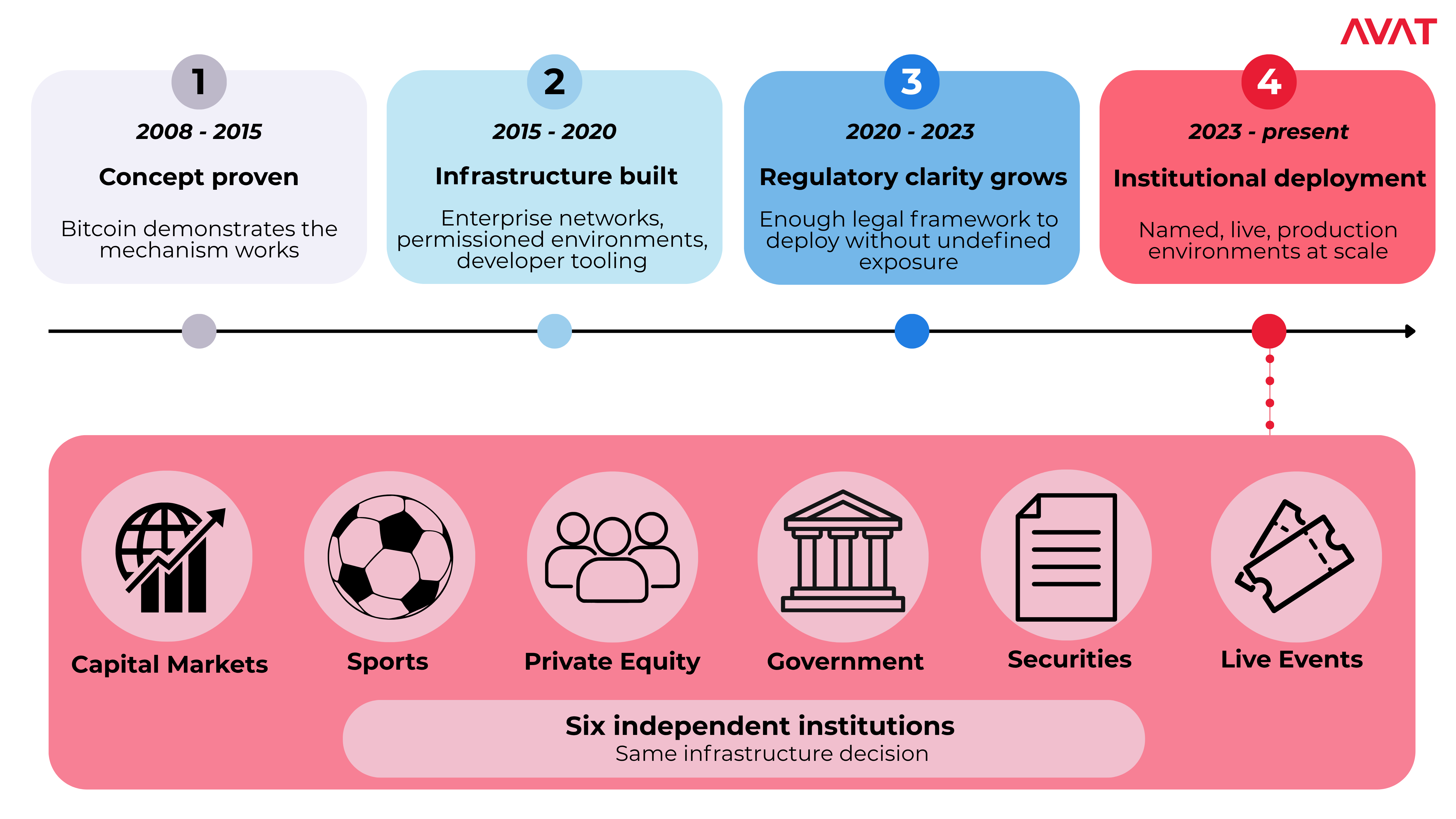
Transaction speeds on major networks are now measured in seconds rather than minutes. Enterprise-grade permissioned environments allow institutions to build on blockchain while maintaining the privacy and access controls their compliance functions require. Regulatory clarity, while still incomplete, has advanced far enough in major markets that institutions can deploy without undefined legal exposure. And perhaps most importantly, enough major institutions have deployed in live production environments to create reference points for others.
The analogy: The first airline to fly a transatlantic route took on enormous risk, not just of the flight, but of operating in a regulatory and infrastructure environment that didn't fully exist yet. By the time the route became routine, most of that risk had been absorbed by the early movers. Institutions that are moving now are later than the pioneers, but earlier than the mainstream. The infrastructure question has largely been answered. The implementation question is what remains.
The pattern worth understanding
Every major infrastructure cycle has followed the same arc. Early adopters deploy at the edges, absorbing risk and demonstrating feasibility. Established institutions watch, evaluate, and wait for enough reference points to reduce uncertainty. Then adoption moves from exploratory to operational.
Blockchain is now at the point in that arc where established institutions, not just startups, are deploying in live environments. Broadridge on shareholder governance. The California DMV on vehicle titles. KKR on private equity access. FIFA on fan infrastructure. Japan's dominant digital securities platform on tokenized securities.
These aren't pilots. They are production deployments, operating at institutional scale, under institutional compliance standards.
What this means for how you engage with the topic
Understanding blockchain now means understanding it at the moment when the institutional infrastructure question has been largely resolved, and the question has shifted to which organizations will build on it, in which areas, and at what pace.
That's the question the rest of this Hub is built to help you answer.
You've finished the foundational layer. Choose your track.
- For executives evaluating blockchain for their organization: Executive track
- For investors reading adoption signals and evaluating opportunities: Investor track