Before you can evaluate whether blockchain matters, you need to understand what it's solving for.
The answer isn't "making things digital." Most processes are already digital. The problem is something more specific: even when information is digital, it often has to travel through a chain of intermediaries before anyone can trust it.
The reconciliation problem
When two institutions do business with each other, they each keep their own record of the transaction. At the end of the day, week, or month, someone has to reconcile those records and confirm they match. When they don't match, which happens more than most people realize, someone has to find the discrepancy and fix it.
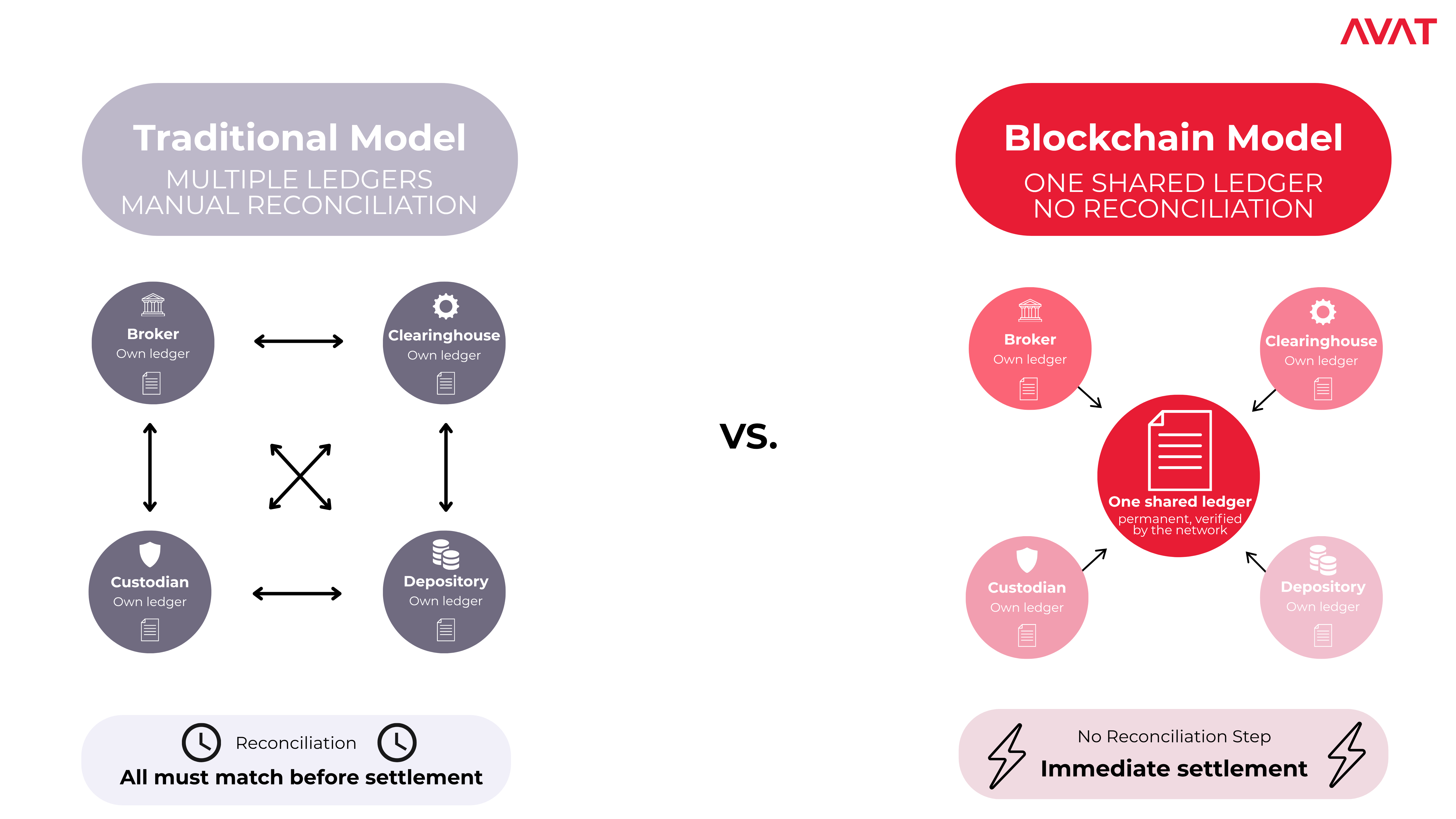
This is called reconciliation, and it is one of the most expensive, time-consuming, and error-prone processes in institutional finance and operations.
The TradFi equivalent: Securities settlement. When a trade is executed, the actual transfer of securities and cash doesn't happen instantly. It takes two business days (T+2) because multiple parties, the broker, the custodian, the clearinghouse, the counterparty, all need to independently verify and record the transaction before anyone can be sure it's final. Capital sits idle in that gap. Counterparty risk persists until it clears.
The analogy: Imagine four departments in the same building all keeping separate spreadsheets of the same data, and a full-time team whose only job is making sure the four spreadsheets say the same thing. Blockchain makes that team unnecessary by giving everyone access to one shared spreadsheet that updates in real time.
Why the middleman model creates specific costs
Every intermediary in a process adds three things: time, cost, and a point of failure. The time delay is often measured in days. The cost is fees paid to each intermediary for their verification role. The point of failure is the risk that any single party in the chain has an error, a breach, or an outage.
In low-stakes situations, these costs are acceptable. In high-frequency, high-value, multi-party processes, they compound into significant operational drag.
What blockchain changes
When a transaction is recorded on a blockchain, it settles immediately, the record is permanent, and every authorized party can verify it without waiting for someone else to confirm. There is no reconciliation step because there is no separate record to reconcile. There is one shared record, and everyone who needs to see it can.
This is why institutions across capital markets, government, private equity, and live events are building on blockchain. Not because it's new, but because it solves a specific, expensive problem they already have.
Three questions to ask about any process
- Does this involve multiple parties who each keep their own record of the same event?
- Does this require a trusted intermediary whose job is to verify and reconcile?
- Is the cost of that intermediary, in time, fees, or risk, significant enough to be worth solving?
If the answer to all three is yes, blockchain is worth understanding more specifically.