Every significant technology investment gets pitched as a way to make existing processes faster. Blockchain does something different.
It doesn't make existing processes faster. It changes the point in the process where the work gets done.
This is an important distinction, and it's worth being precise about it.
The standard technology pitch
Most enterprise software promises to automate, accelerate, or streamline a process that already exists. A faster reconciliation tool still requires reconciliation. A better trade confirmation system still requires confirmation. The work is the same. The speed changes.
What blockchain changes
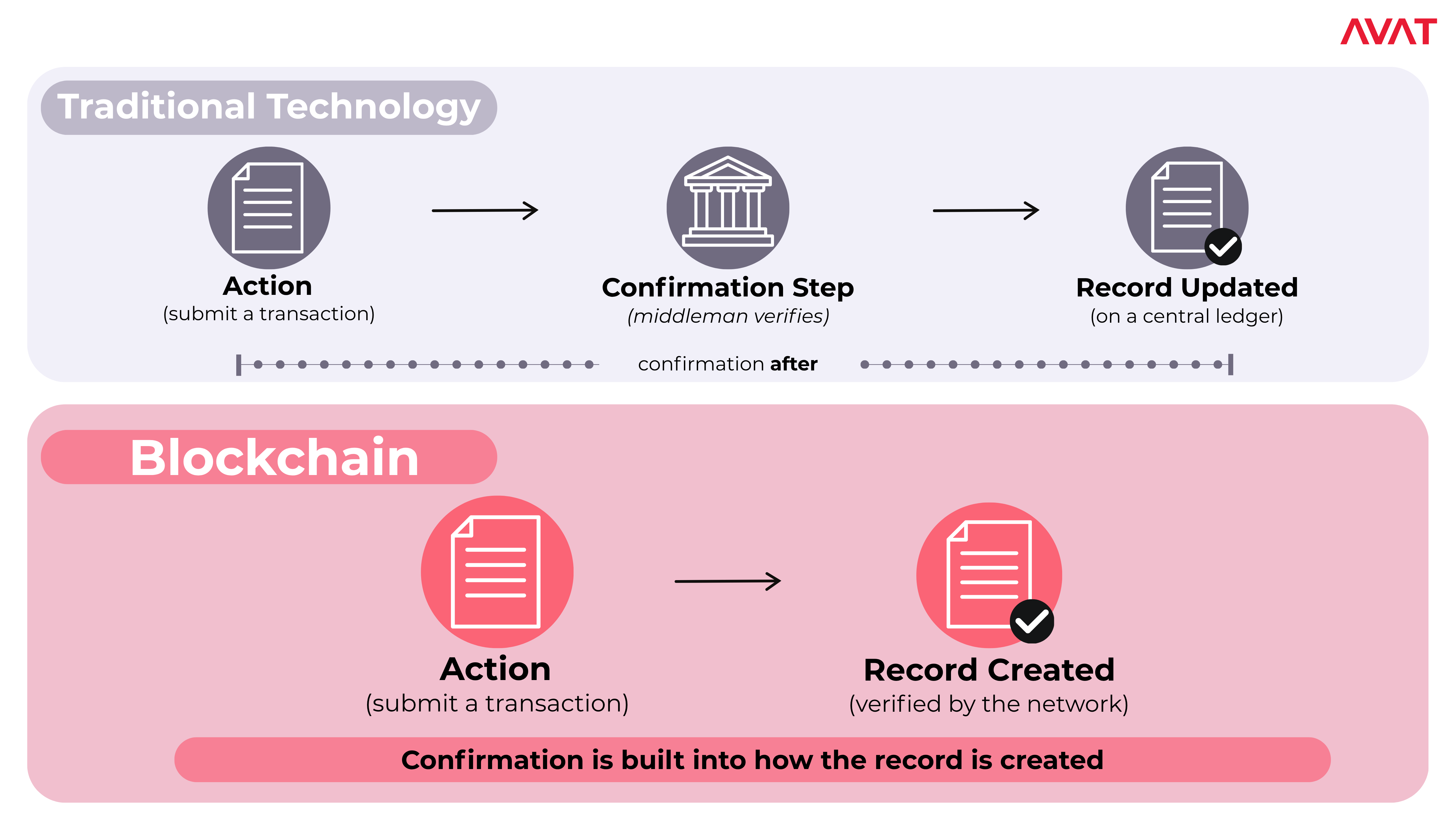
With blockchain, the verification step moves. Instead of happening after the transaction (as a separate reconciliation or confirmation process), it happens as part of the transaction itself.
When a trade settles on a blockchain, the settlement is the record. There is no separate step where someone confirms the trade happened and updates their ledger. The confirmation is built into how the record gets created.
The TradFi equivalent: Consider the difference between a wire transfer and a cash transaction. A wire transfer creates a record that then has to be matched, confirmed, and settled over hours or days. A cash transaction is final the moment it happens. Blockchain moves most financial transactions closer to cash: the transaction and the settlement are the same event.
The analogy: Most technology investments are like hiring a faster postal service. The letter still has to be written, addressed, sent, received, opened, read, and replied to. Blockchain is more like replacing the postal system with a phone call. The communication and the connection happen simultaneously. The steps in between disappear.
Why this matters for evaluating specific use cases
The right question to ask about any proposed blockchain application isn't "will this be faster?" It's "does this eliminate a step that currently requires a trusted intermediary?"
If the answer is yes, blockchain is potentially solving a structural problem, not just a speed problem. Structural solutions tend to have more durable value than speed improvements, which can always be beaten by the next faster tool.
If the answer is no, and the process still fundamentally requires a middleman or a separate confirmation step, then blockchain may be adding complexity without adding structural value.
Three examples of the structural difference in practice
- Shareholder voting moves on-chain. The vote and the record of the vote happen simultaneously. There is no separate reconciliation to confirm who voted and how. Audit is instant.
- A government title registry moves on-chain. The transfer of ownership and the update to the official record happen as one event. There is no separate step where the DMV processes and records the change.
- A private equity fund is tokenized. The issuance of a position and the record of ownership are the same event. There is no separate transfer agent step to reflect the ownership change.
In each case, the step that disappeared was the confirmation step. That's the structural difference.