Blockchain is infrastructure. Like any infrastructure, what matters is what you can build on top of it.
The short answer: anything that benefits from a shared, permanent, tamper-evident record held by multiple parties rather than a single institution.
The longer answer requires understanding the three main categories of what gets built on blockchains today.
1. Digital assets
The most visible category. A digital asset is a unit of value that exists on a blockchain. The asset itself can represent almost anything: a currency, a share of a fund, a piece of real estate, a ticket, a collectible, a carbon credit.
The TradFi equivalent: A security held in street name at a custodian. You own it, but it exists as an entry in someone else's ledger. A digital asset is the same concept, except the ledger is the blockchain rather than a custodian's internal system.
What changes with blockchain is who can hold it (anyone with a digital wallet, not just institutional accounts), how it settles (immediately rather than T+2), and how ownership can be divided (a $10 million building can be broken into 10,000 pieces and held by 10,000 people, in ways that paper ownership structures make prohibitively complex).
2. Smart contracts
A smart contract is a set of rules written into code and stored on a blockchain. When the conditions in the contract are met, it executes automatically. No human has to trigger it, approve it, or process it.
The TradFi equivalent: An escrow account with automatic release conditions. When certain criteria are verified (funds received, inspection passed, title cleared), the escrow releases. A smart contract is the same logic, except it executes on the blockchain rather than requiring an escrow officer to confirm and process.
The analogy: A vending machine. You insert the right amount of money, the machine verifies the condition is met, and it dispenses the item. No cashier required. Smart contracts are vending machines for agreements.
What changes is that the execution is automatic, verifiable, and doesn't depend on any single party's discretion or availability. This is why smart contracts are central to anything involving complex, multi-party, rules-based transactions.
3. Tokenization
Tokenization is the process of representing an asset, a right, or a piece of infrastructure as a token on a blockchain. It's not a new asset class. It's a new way of representing existing ones.
Real estate, private equity, fixed income, intellectual property, and governance rights (like shareholder votes) have all been tokenized in live production environments. Each one is doing the same fundamental thing: putting a record of ownership or rights onto a shared ledger rather than keeping it in a private system.
The TradFi equivalent: Securitization. Taking an illiquid asset (a pool of mortgages, a commercial property) and issuing tradable instruments that represent a claim on it. Tokenization does the same thing, but the instrument lives on a blockchain rather than in a transfer agent's system.
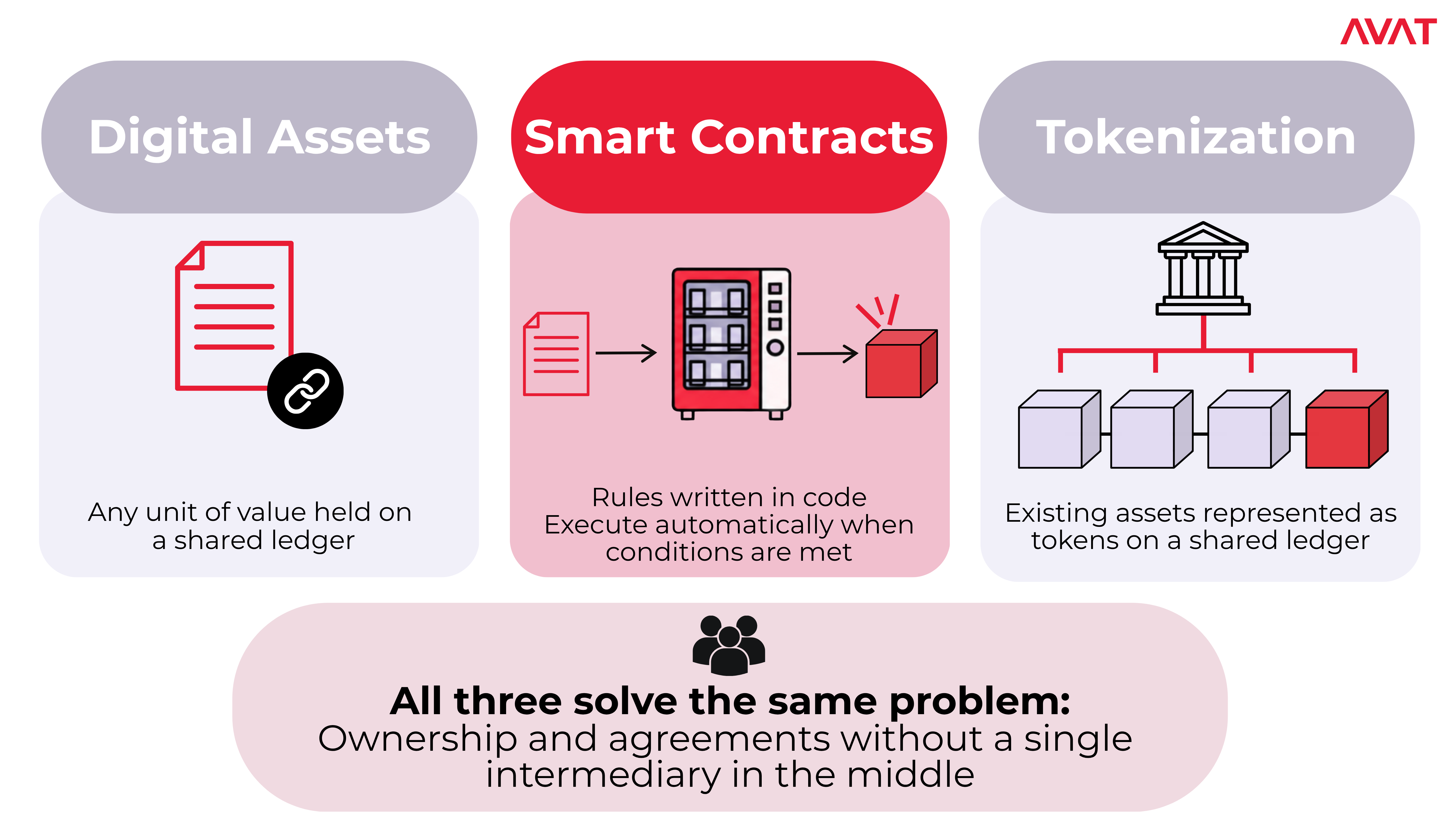
What all three have in common
Every application in these three categories is solving the same underlying problem: how to create, transfer, and verify ownership or agreements across multiple parties without requiring a single trusted intermediary in the middle.