You don't need to understand how blockchain works technically to understand how it works behaviorally. And the behavioral logic is what actually matters for evaluating it.
Here's the core of it.
Transactions don't just happen. They get agreed upon.
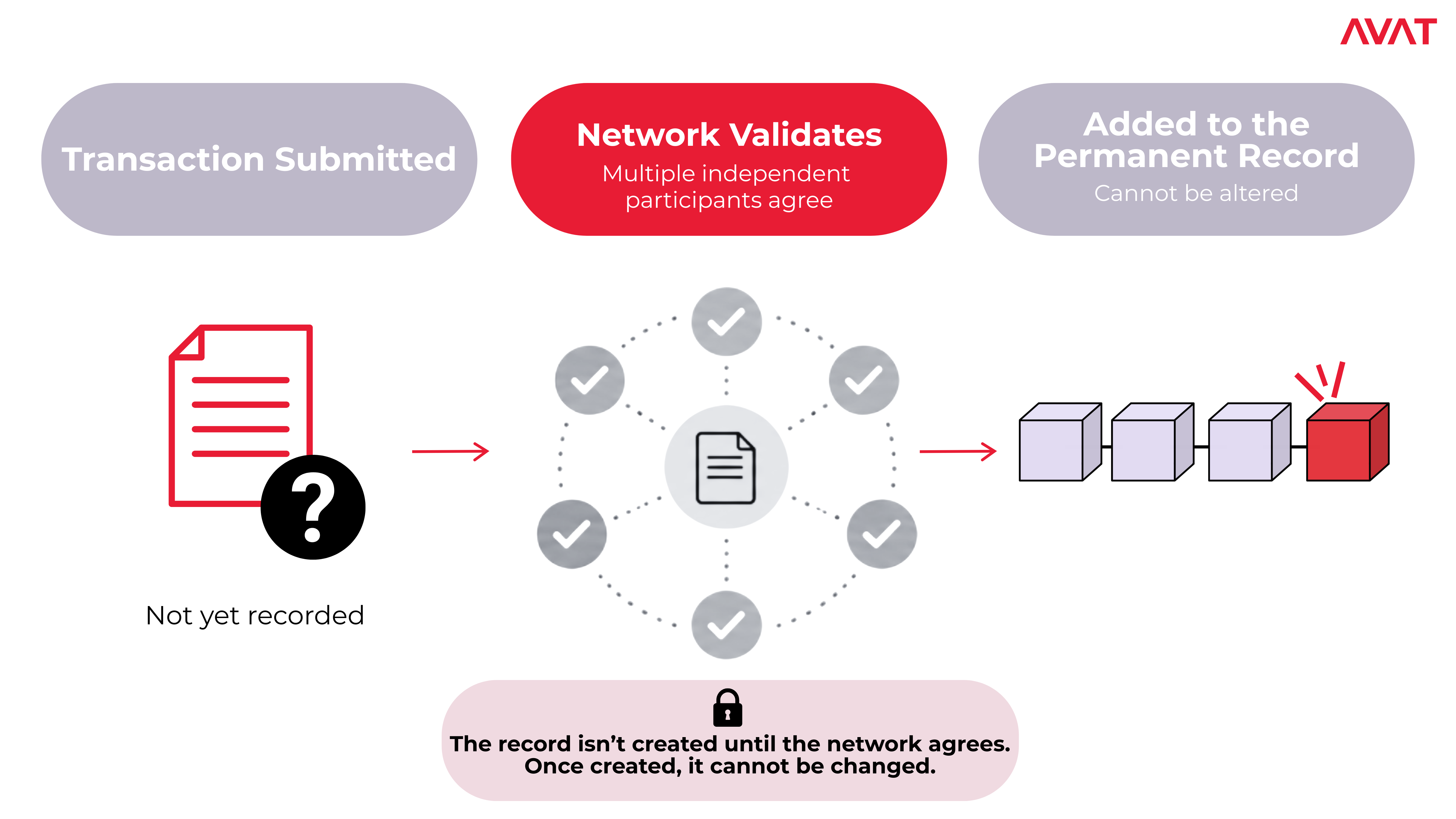
When a transaction is submitted to a blockchain network, it doesn't get recorded immediately. First, it has to be validated. The network, which is made up of multiple independent participants, checks that the transaction is legitimate. Only once there is consensus among enough participants does the transaction get added to the record.
The TradFi equivalent: A syndicated loan. No single bank makes the decision unilaterally. Multiple lenders have to agree to the terms before the loan closes. Blockchain validation works on the same logic, except the "lenders" are participants in the network, and the agreement happens in seconds rather than weeks.
The analogy: A notarized document. One signature isn't enough. Multiple witnesses confirm the document is authentic before it's considered official. Blockchain replaces the witnesses with a network of validators, and the notary with code.
Once validated, the record is permanent
This is the property that makes blockchain useful for audit trails and compliance. Once a transaction is recorded, it can't be quietly changed. Any attempt to alter a past record would be immediately visible to the entire network. The record isn't stored in one place that can be edited by one administrator. It's stored across many participants simultaneously, which means changing it would require controlling enough of the network to override everyone else's copy.
In practice, for any serious blockchain network, this is computationally and economically prohibitive.
Blocks and chains
The name gives a hint. Transactions are grouped into blocks. Each block includes a reference to the block before it, which is how the chain forms. This linkage is what makes the history tamper-evident. Changing any record in any block would break the link to every block that follows it, which the network would immediately detect.
The analogy: A bound book with numbered pages, where each page references the page before it. If you try to tear out or alter a page, the numbering breaks and the gap is obvious. Blockchain creates the same structure, except the book is held by thousands of participants simultaneously.
What you don't need to know
The underlying cryptography, the specific consensus mechanisms (proof of work, proof of stake, and their variants), the node architecture, and the specifics of how different blockchains implement these ideas all matter enormously to engineers. They don't matter for evaluating whether blockchain is the right infrastructure for a given use case.
What matters is the behavioral outcome: multiple parties independently confirm, the record is created, and nobody can change it unilaterally afterward.